15 September 2026 · Creative proposal, not an approved production library
The sentence every asset must serve
I am in a beautiful, inhabited place; what I choose to notice changes what I can do here.
The world is a fictional simulation with discoverable rules. Its larger cosmology stays mysterious. People, objects and natural patterns have enough consistency that curiosity is rewarded.
1. Visual direction: a humane future made by hand
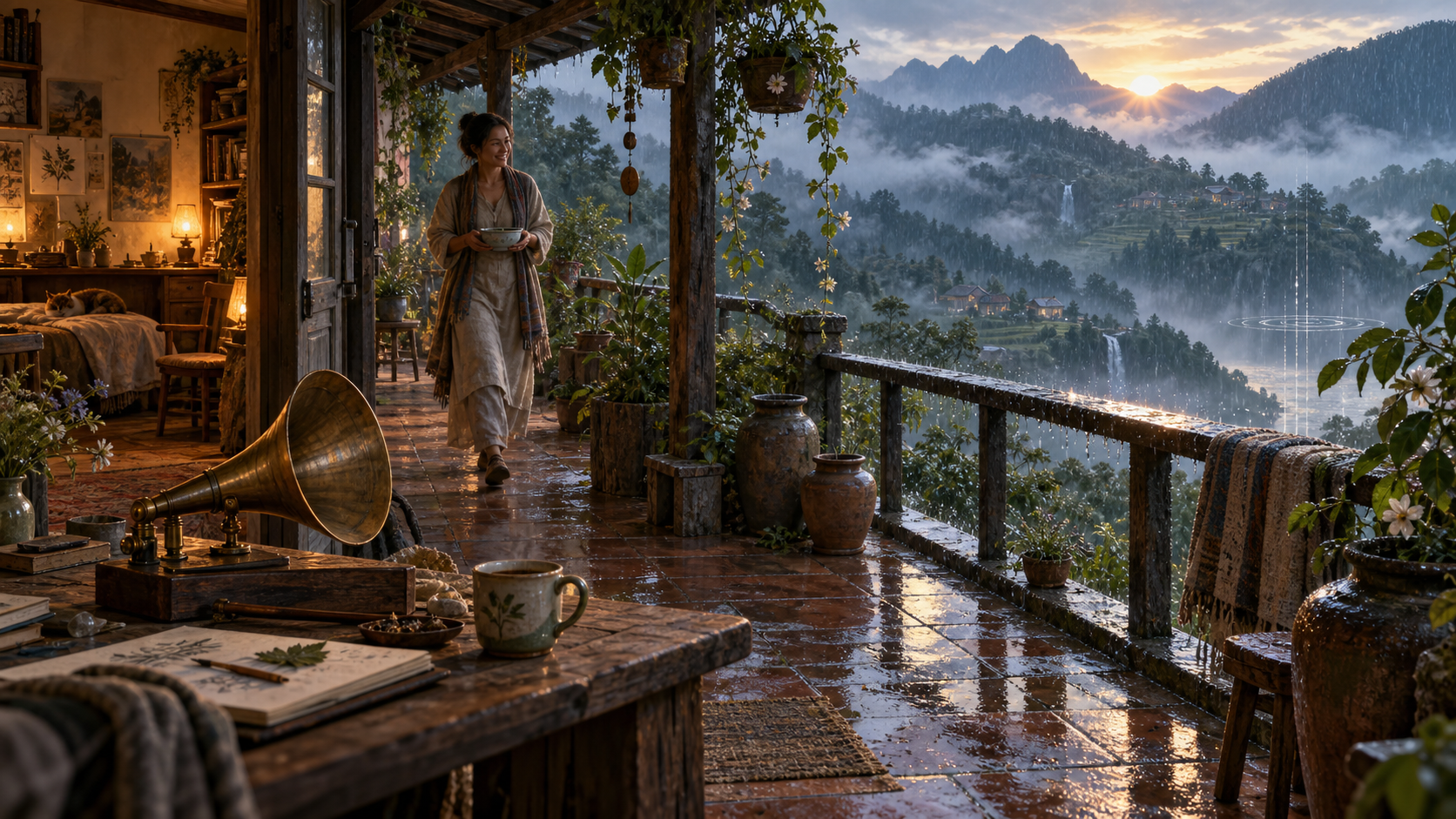
One sheltered artist's room and terrace overlook a misty landscape. Human craft is visible at every scale: joinery, a repaired ceramic edge, a woven curtain, annotated paper, a brass instrument built for a purpose. Technical sophistication appears through precision and responsiveness rather than decorative screens everywhere.
The future-society ambition begins here: things are maintained, knowledge is shared without condescension, people retain different temperaments and private lives, and a player can care for a place without being morally scored. Generosity is an action with context, not a currency.
Provisional palette and materials
These are starting display swatches, not final shader values. Convert and review under the selected color-management pipeline before adoption.
| Family | Starting swatch | Role and limits |
|---|---|---|
| Deep teal shadow | #213C3B |
Cool exterior depth; retain readable forms |
| Mist | #BBCAC5 |
Air and distant layers, never a blanket hiding interactions |
| Warm plaster | #C9B796 |
Interior bounce, paper and quiet backgrounds |
| Fired earth | #8A5845 |
Terracotta and handmade ceramic families |
| Aged brass | #A88A55 |
Functional mechanisms and selective highlights |
| Linen | #DDD3BB |
Clothing, cloth and notebook surfaces |
| Anomaly silver | #CAE0DC |
One localized phenomenon; reserved to preserve meaning |
Build a small physically based material library: aged wood, glazed/unglazed ceramic, brass, stone/terracotta, linen, paper, foliage and water. Share calibrated roughness/normal scales. Wetness is a controlled variation with a maximum that preserves silhouette and clues. Do not replace the palette by recoloring unrelated marketplace assets at random.
Shape and composition
- Architecture is supported and usable; rooms have circulation and credible joins.
- Props repeat a few recognizable construction details and curves. Functional mechanisms have understandable moving parts.
- Human silhouettes remain distinct from the environment and are usually visible in medium or full-body composition.
- The room has three clear depth layers: near work surface, people/terrace, distant landscape. Atmospheric perspective keeps them legible.
- Give each ordinary playable view a focal hierarchy. Texture density is lower where captions, clues and hands need attention.
- Maintain a measured camera range. Proposed first slice: first-person at human eye level, a short freely traversable room/terrace and player-controlled inspection. Keyboard/mouse and controller; no default head bob or forced cinematic cut during an active choice. Validate comfort and contact animation before extending navigation.
Light and time
Use three authored morning lighting states, with transitions only at disclosed progression beats. Warm interior light and cool rain provide separation. The reveal briefly aligns an existing pattern rather than repainting the whole world. Test the darkest playable state first; do not solve readability with oversized HUD markers.
Maintain a deliberate exposure range. Bloom and depth of field are restrained and cannot hide controls. Camera shake, film grain, chromatic aberration and motion blur are optional and default off unless a tested artistic need justifies them. The aesthetic survives reduced motion and lower effects settings.
2. Character and performance
Neighbor
A fictional adult with their own work, knowledge and uncertainty. A practical opaque costume with tactile cloth, a recognizable silhouette and a few durable personal details. Prepare front/side/back model sheets, scale beside the device and doorway, face/expression reference, costume construction and material breakdown before generating variants.
The same model carries every appearance. Change expression, pose or lighting through the rig and scene; do not regenerate a new face for every dialogue. Existing Déoviá performers or voices require explicit selection and appropriate source permission; this kit adopts none automatically.
Minimum performance set: working idle, notice player, shift attention, walk/turn/stop, listen, point to a meaningful feature, reach/release, explain uncertainly, acknowledge a discovery and return to work. Record when gestures interrupt and how they resume.
Hands and contact matter more than a large animation count. The arm must reach the same object in the same place. Verify foot plants, object grip, handoff ownership and gaze targets. Do not solve poor performance by permanently hiding hands or cutting to close-ups.
Companion
Start with scripted, event-grounded text and optional recorded voice. Give the companion an identifiable sound/visual presence only after its form is selected. Keep initial lines brief enough that observation remains the player's activity.
Examples of voice direction:
- Observation: “You held the interval. The second line stayed.”
- Testimony: “That is how she remembers it.”
- Uncertainty: “It repeats. We don't know why yet.”
- Requested hint: “Watch the gap after the fourth beat.”
These lines are drafts. The game must only use an observation if its supporting event exists. No idle line claims a visit, discovery or action that never happened.
3. The ten-minute artistic proof
Approximate pacing targets, not enforced timers or measured playtime.
| Beat | Player activity | Artistic job | Required consequence |
|---|---|---|---|
| Arrival | Look, move between permitted views, inspect a material/object | The world feels inviting before exposition | An inspection changes a readable object response |
| Notice | Compare an ordinary rhythm with an irregularity | Sound and rain direct attention gently | A specific observation is recorded |
| Commit | Choose a morning practice; see the alternative it defers | A quiet meaningful choice, clear time boundary | Exactly one practice consumes the beat |
| Practice | Predict an interval and place a marker; revise if wrong | Control, sensation and feedback agree | The player learns an action, not just a statistic |
| Discover | Use the learned action during rain | A brief geometric alignment feels earned | Different evidence from baseline inspection |
| Keep | Record the observed trace and inspect it | A made thing becomes personally meaningful | Evidence survives a save/reload |
| Breathe | Remain, inspect, speak briefly or finish | Space for the feeling to settle | No forced share, upgrade or next task |
First complete Stillness. Then build Craft and Connection as distinct physical/social investigations of the same place. A basic observation and mixed approach must complete. Inheritance remains a later compatible scene.
4. Asset inventory: finite first batch
Every entry is planned unless explicitly stated otherwise. This is the production backlog; IDs are proposed stable references.
| ID / group | Deliverable | States and dependencies |
|---|---|---|
| ENV-001 | Measured room/terrace blockout | Camera bounds, circulation, reachable work surface, neighbor zone |
| ENV-002 | Modular architecture kit | Floor, wall, doorway, post, rail, roof/eaves; shared grid and material families |
| ENV-003 | Distant landscape | Compatible lighting and scale; decorative geometry kept outside interaction rules |
| ENV-004 | Small foliage family | Shared leaf response, bounded movement, dry/sheltered/wet variants |
| PROP-001 | Rain instrument, hero object | Unfinished, calibrated, producing trace; stable handle/knob/contact anchors |
| PROP-002 | Notebook, hero object | Closed, inspect, observation added; accessible text rendering independent of page texture |
| PROP-003 | Simple rain/listening marker | Base and placed states; clear visual timing information |
| PROP-004 | Cup and small craft set | Idle, inspected, physically touched where used; no ornamental interact prompts |
| PROP-005 | Furniture/cloth kit | Worktable, seat, shelf, curtain; camera/hand clearance and stable placement |
| CHAR-001 | Neighbor canonical source | Model sheets, mesh, rig, costume, material set, expressions and performance set |
| CHAR-002 | Companion presentation | Form decision pending; scripted text fallback works without model calls |
| PLAYER-001 | Player embodiment | Proposed first-person interaction hand rig for the hero gesture; body/avatar customization deferred; validate hand/device contact before other animations |
| MAT-001…008 | Eight material families | Dry/wet variants, calibrated engine preview, shared names and revision IDs |
| FX-001 | Rain system | Near/mid/far depths, sheltered boundary, puddle response, low-effects alternative |
| FX-002 | Mist and atmospheric depth | Stable visibility, no collision with captions/important silhouettes |
| FX-003 | Grid anomaly | Baseline, timing view, instrument trace, reduced-motion presentation |
| ANIM-001 | Device operation | Reach, grasp, adjust, release, interrupt; exact PROP-001 contact coordinates |
| ANIM-002 | Neighbor performance set | CHAR-001 rig and props; natural rests, gaze and hand contact |
| AUDIO-001 | Room/terrace/rain ambience | Spatial crossfade, no obvious seam, pause/volume controls |
| AUDIO-002 | Interaction cues | Device adjustment, successful/unsuccessful prediction, page handling; visual equivalents |
| AUDIO-003 | Minimal music stems | Sparse bed and earned reveal accent; silence, smooth transitions, dialogue clearance |
| VOICE-001 | Companion/neighbor lines | Script/event IDs, performance notes, captions; optional recorded speech |
| UI-001 | Interaction language | Inspect/adjust/listen/ask/record; keyboard/controller focus and remapping |
| UI-002 | Notebook evidence view | Observation/testimony distinction and causal source |
| UI-003 | Session screens | Start/continue, two saves, settings, time commitment, export/import, recovery |
| CAPTURE-001 | Reference scene suite | Twelve views/states defined below, then real engine captures |
| BUILD-001 | Native proof packages | Mac and Windows, exact content/asset/rules manifest and verification receipt |
The earlier scene concept exists only as an AI-generated exploration. Its distant circular effect and some prop choices need reconciliation with the subtle original grid premise. It cannot serve as a locked environment plan or an in-engine acceptance image.
5. Twelve reference scenes
Create these as reproducible engine scenes/checkpoints after the first assets exist. Record camera, input, simulated time, quality level, captions, event state and platform. Capture motion as well as stills.
- Interior arrival, ordinary quiet state.
- Transition to covered terrace with rain outside the shelter.
- Instrument wide view: where and how to act is clear.
- Instrument close inspection: same object/materials, readable moving parts.
- Neighbor medium/full-body conversation with subtitles.
- Neighbor reach/contact and return to idle.
- Stillness prediction and incorrect attempt.
- Stillness success and bounded reveal.
- Craft trace after the rain ends.
- Notebook evidence and long localized text.
- Darkest state on minimum quality with reduced motion and muted audio.
- Continue/reload with a previously recorded discovery.
For all of them, review the whole frame and intended action. An isolated prop render or passing image similarity score is insufficient. Hash the accepted suite and store approval outside candidate write access.
6. Asset production rule
An asset moves through briefed → candidate → edited → imported → tested → reviewed → approved. Only the approved derivative is eligible for the production manifest. Approval is attached to a specific hash/version; a changed output returns to review.
Every object has one creative function, a canonical editable source and an identified human decision owner. Record why it was accepted, not just a star rating. Maintain a small rejected-example board. A new tool must fit the same contract before it can contribute production assets.
Before widening the inventory, finish a 60–90 second proof: one prop from source to actual hand contact, one rainy view and one recorded consequence that survives reload. Then add one neighbor action and complete the route. These expose the costly integration problems that concept art cannot.